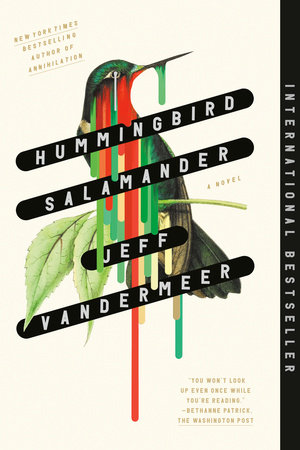
Hummingbird Salamander is a book by Jeff Vandermeer published on April 6th, 2021. It follows the story of Jane, a security consultant who receives a key to a storage unit owned by the enigmatic Silvina Vilcapampa. Inside is a taxidermy hummingbird, and a mystery to find a taxidermy salamander.
‘New Weird’ is one of the newest underground movements in literature, one pioneered by author Jeff Vandermeer. His definition of what ‘New Weird’ is as follows:
“…a type of urban, secondary-world fiction that subverts the romanticized ideas about place found in traditional fantasy, largely by choosing realistic, complex real-world models as the jumping-off point for creation of settings that may combine elements of both science fiction and fantasy.”
The New Weird Anthology by Jeff Vandermeer
That’s from the foreword of the collection curated by him and his wife Ann Vandermeer. Which is appropriate. All of Vandermeer’s work falls squarely into the ‘new weird’ and thanks to the success and film adaptation of Annihilation, means he is probably the most famous voice in the genre.
Which is what makes Hummingbird Salamander weird. Precisely that there isn’t much weird about it. It’s set in a world much like our own about a woman, hummingbird, salamander and ecoterrorism.
So I was immediately intrugued. I don’t think that authors and artists should be confined to one genre or style, but it is always fascinating when someone goes against the grain of their previous work. And so, alike many filmgoers sitting down to watch Todd Phillip’s Joker (whose previous directing credits include all the Hangover movies), or those listening to Kanye West’s gospel album, I started to read Hummingbird Salamander.
A Huge Departure
If you are likely to know Jeff Vandermeer from anything, it is his big breakout hit and first book in the Area X Trilogy: Annihilation, which was later adapted into a film, both of which are fantastic.
Of his works I have read the Area X Trilogy, the Ambergris Trilogy, Borne and Dead Astronauts. To give you an example of how weird they get, Annihilation is mostly centered on a hole in the ground in the Shimmer. The hole has a staircase and our main character, Ghost Bird, is compelled to call it The Tower. In The Tower is a large slug-like creature writing a neverending sentence on the walls in an ink made of living organisms.
Ambergris is a steampunkesque otherworldly city inhabited by humans and benign, silent mushroom men. One day, while a lot of the townsfolk are hunting a giant squid, they return to a totally empty city with no sign of struggle or where the rest of the people went.
Borne takes place in a nameless post-apocalyptic city ruled over by a 5 storey tall flying bear named Mord.
So yeah, a book set in pretty much our own world with all simply human characters stood out.
And I didn’t just not like it because its not weird. There are a lot of reasons why, but the root cause comes down to the fact that I did not care.
1. A Mystery Impossible to Solve
The heart of Hummingbird Salamander is a mystery to solve. Our main character ‘Jane’ (she changed her own name in the retelling to protect her identity, as well as others in the book), a former wrestler/body-builder who now works in cyber security.
One day, sitting in a cafe, the barista handed her a note with an address and a unit number. The address is an abandoned storage building, and in the storage unit denoted is a taxidermied hummingbird with a note to find a taxidermied salamander.
The note comes from the owner of the storage facility, Silvina Vilcapampa, daughter of a rich entrepeneur and possible ecoterrorist. A quick google search shows she died the week before the start of the story.
Its a compelling enough start. Where is the salamander? What is this leading to? Why did Silvina pick a total stranger to give this task to?
A big part of the enjoyment of a mystery thriller is trying to guess what the solution to the mystery is. Who is the killer? What was the murder weapon? etc. And its fun to either guess it right and brag, or get it wrong and try to put the pieces together retroactively.
That’s the joy of reading and/or watching a mystery for a second time, knowing the solution. Suddenly, little things make more sense, and you catch clues that you missed the first time around.
How is the mystery solved in Hummingbird Salamander? Well, the first thought goes to whoever taxidermied this rare hummingbird. Jane follows up on it, but it ultimately goes nowhere except the taxidermist threatening her to give up on following the trail.
So then Jane pops the eyes out of the hummingbird, finds two numbers on each, which correspond with an address that Silvina owned. There Jane finds a diary, that leads her to Unitopia and a storage unit filled to the brim with taxidermied rare animals. After being captured, Jane determines the bad guys have the salamander, so she steals it back and the address on its eyes leads her back to the farm she grew up on.
And so on and so forth, until the book ends. The problem with each and every one of these points is that they are impossible to see coming, and not in a good way. She finds the numbers on the hummingbird’s eyes, but it is near impossible to figure out that they are an address, especially without a road name. There have to be thousands of buildings with the same number. And nowhere before is this address mentioned.
Maybe if the address was buried in the book somewhere, list off different addresses that Silvina owns, and it would be better. Very eagle eyed viewers would see it and recognize it, but most wouldn’t.
And that’s a problem. The book is a series of mysteries that have no clues on how to solve them. The answer doesn’t exist until Vandermeer reveals it later. By the time Jane finds the salamander, all thrill of trying to solve the mystery and engagement of that sort is gone. Its just “Let’s see where this goes next, there’s no way of knowing.”
And then, near the end, as if to try to keep the attention of readers, Vandermeer pulls out all the surprising stops. It leads to her family farm! The grandfather she killed is still alive! (Turns out its her estranged and aged father, but it is presented when she first meets him as her grandfather) Surprise! It turns out Silvina grew up right next door to Jane! Surprise! Jane’s husband is there! Surprise Langer wasn’t killed! Surprise Hellmouth is here! Surprise the whole thing led back to the storage unit that originally held the hummingbird! Surprise Silvina didn’t die a week before Jane found the hummingbird, but she’s dead now!
But its too little too late. Most of these twists don’t have a basis earlier in the story, and happen too quickly one after another to be effective.
2. Action at Arm’s Length
Okay, but all that isn’t a death sentence. After all, this isn’t an all out mystery story. There’s some action, there’s some suspence and thrills.
Unfortunately they all come a little too little, and a little too late.
As previously mentioned, Jane works at a cyber security company, so she knows the risks in this online world. So when first dipping her toes in the mystery of the hummingbird, she takes all precautions. Using coworkers’ computers, getting her assistant to do it under the guise of company research, buying burner phones, the works.
The thing is that there is no inciting incident for this behaviour. Which is fine, but for the first half of the story there is no contact between Jane and the shadowy ‘bad guys’ that supposedly want to do her harm.
A kooky gym owner tells Jane he thinks she’s been followed. There are remains of cigarettes and beer at the back edge of the property, and nothing changes. Jane just continues on.
Which could work if we were supposed to question how important this is. But never once is the question brought up if Jane is crazy or just seeing things. We are just supposed to assume she is in danger from a net slowly closing in on her.
And then the first interaction with the villains of the book is Jane beating up some random thug with complete ease. Not exactly the most intimidating of entrances, especially over a third of the way through the book.
In fact, most meetings (and there aren’t many) easily go in favour of Jane. The highlight of the book easily is the storage unit filled with rare taxidermy that Langer sets on fire with Jane inside. She escapes, but is captured in one of her few moments of weakness.
However, after being nearly burnt alive, shot multiple times and drugged, Jane escapes her captors after stealing the salamander and getting shot again and jumping out the window of a second storey floor.
That fall has massive implications, as Jane needs to walk with a cane for the rest of the story (which jumps ahead two years) but she still manages to escape from her captors. She outsmarts Langer with an explosive houseboat, gets the information to solve the mystery from the villains and even nearly kills Langer, a man everyone says is hard to kill, in hand-to-hand combat while crippled.
That and one time the villains shoot at Jane from really far away and miss and kill someone else unimportant to the story are the interactions Jane has with the villains. The baddies are incompetent to say the most, completely unthreatening to say the least. Because of Jane’s precautions early in the book (which does make sense and is in her character to be fair), the villains come in far too late into the story and are far too incompetent to care about.
3.5 Plotholes
Plotholes are kind of hard to talk about. An engaging story is good enough to make a lot of people forgive them, but in a bad story, people go out of their way to nitpick them. Like Langer jumping off an exploding houseboat into rapid rushing water and being swept downstream only to appear later in the finale. Is that a plothole? Maybe. Its unlikely that Langer could survive, but is possible and very nitpicky and the kind of thing I don’t hold against the book.
There are a couple of plotholes in Hummingbird Salamander that are more serious. Integral to the plot serious. I like to think these are serious problems, but fair warning.
The aforementioned twist that Jane’s brother worked for Silvina, dated Silvina and that Silvina lived right next door to Jane took me aback when I first read it. Clearly there is some connection between Silvina and Jane from the opening page, but like this?
The flurry of revelations makes it hard to process in the moment, but thinking on it later, it makes even less sense than I thought it did. Jane is very good with technology and navigating the world of large corperations. Its her job. However, while digging through all the properties and pieces of land the Vilcapampa company owns, she never comes across this one? She never ran into Silvina in the past, even when she was spending a lot of her time off the property to get away from a broken home?
And then her brother worked for her collecting rare salamanders. The excuse given as to why Jane didn’t know this was that her brother and borderline absentee parents didn’t want her to know that her brother was illegally collecting wildlife.
It is something that is small enough to ignore if the rest of the story holds up, but unfortunately, the rest of the story feels lacking, especially when it comes to…
4. Other Characters
Possibly Jeff Vandermeer’s greatest strength in his writing is his point of view character. Most of his books are written in first person or really tight third. Hummingbird Salamander is written from the point-of-view of Jane, Annihilation is supposed to be the actual journal of the biologist, Borne is the point-of-view of Rachel, and Authority is third person, but totally focused on the character of Control. The City of Saints and Madmen is a collection of short stories, and Dead Astronauts eschews all form of conventional storytelling for better and worse.
Whether its first or third, all of Vandermeer’s stories are very tightly focused on one character, and he is extremely good at getting you into that character’s headspace and really exploring the character.
And Hummingbird Salamander is no different. Jane is a very good, fleshed-out character. She has a good internal monologue, and it is very clear why she takes certain actions in the novel and her motivation.
Except, I cannot connect with them, and it is a problem with the other characters in the story. There are the characters on the margin, like Jane’s husband, daughter and assistant, who all play their small parts well.
It is the more important side characters that feel lacking. The characters tied to the titular hummingbird and salamander are shrouded in shadow, and it makes it hard to care for Jane’s motivation throughout the story.
Let’s go through them, from least to most important.
4.1 Langer
Langer fills a very rudimentary role in the story, and fills it merely satisfactorily.
He is the ticking clock, the roadblock, the villain. He is similar to the guy Indiana Jones has to beat up right before the climax of the movie. The shirtless guy chopped up by the propellor, the big cultist, the general in the tank, the guy that gets eaten by ants.
Langer is described as cunning, ruthless and hard to kill. He is the man that brought Silvina into the world of ecoterrorism and is considered the most volitile of the three characters in their little triangle (more on that later). Its assumed that Langer is on the trail of the salamander in an attempt to use whatever it is pointing to as an ecological weapon.
The problem is that we know so little about Langer, because he interacts with Jane twice in the book, and then subsequently dies.
His men are easily spotted and physically subdued by Jane, he falls victim to her trap on a houseboat, and is killed by Jane after she is crippled long term by falling out a window.
We don’t know anything about his personality, and everything we see of him is failure. Not exactly the most compelling of henchmen.
4.2 Hellbender
Hellbender, or Jack (both psuedonyms so take your pick), is the most fleshed out of the side characters, largely because he is the only one to have prolonged interactions with Jane the entire book.
The two first meet at a convention at a bar as Jack smoothly seduces Jane, only to disappear later in the night.
Its only later that Jane learns he is tied to this mystery, and that he has her cell phone number, so he can text her and keep track of her whereabouts.
In these texts, Hellbender reveals himself as very intelligent, cunning and manipulative. Jane even learns that Jack has interrogated Langer in the past for some organisation on his environmental crimes. He is even part of the suggested love triangle between himself, Silvina and Langer.
The problem is that the macguffin, the thing that all these characters are chasing, is really vague until the ending of the book. So that makes it that much harder to parce out all the characters’ motivations.
We understand that Langer, being the most villainous and radical of the characters, wants to use whatever it is as a weapon. But we don’t really know about Jack. Is he trying to weaponize it? Does he want to use it for good? Is he just continuing on out of love and comradery to Silvina? And why does he give up so easily?
This confusion just makes his character more confusing and hard to relate to, even in the climax when he and Jane are desperately searching for the end the treasure hunt, we don’t know what it is or what anyone is going to do with it. Its hard to get excited.
4.3 Silvina
Silvina is the most important character in the entire book.
Yes, Jane is the protagonist and point-of-view character, but did you wonder why a computer security consultant who works behind a desk all day with a happy family would give it all up in order to chase this salamander?
The answer, naturally, is Silvina Vilcapampa.
Jane constantly states throughout the book that the reason she persues this mystery is because of some bond with Silvina. She is driven to find out more about this enigmatic woman and where this mystery leads
The problem is that Silvina is either presumed dead, or actually dead, through the whole book. We never meet Silvina in the flesh. Which wouldn’t be so bad in theory.
There are ways to learn about a dead character. Have people talk about this character. Parce out details through their actions in hindsight. Or Vandermeer could’ve broken his dogmatic adherence to the first-person perspective to give us some chapters with Silvina in the past. So we get to know her.
Because at the end of the book, I don’t feel like I know Silvina at all.
I know facts. She grew up rich. Something happened when she was a child that made her jaded against humanity. She got into ecoterrorism and probably blew up a dam. She sold taxidermy. Something happened on a beach between her, Jack and Langer.
But really, I don’t know what actually happened. What made Silvina lose faith in humanity? What was her relationship with the other two? What makes her so special?
I am with Jane to a certain point just on her word of Silvina being so special and important. But when she abandons her husband and daughter, ruins their lives by taking all her money and maxing all the credit cards, falls out of a window causing permanent damage to her body, starting a whole new life on a houseboat; that is so extreme to just do because you are interested in a woman that is already dead and we as the reader know nothing about.
It creates a disconnect between the book and the reader. I feel like I’m missing out on something. I want to know what is so magnetic about Silvina, but have been left wanting.
5. How to Fix It
The way to fix this story is pretty obvious in my opinion.
I would judisciasly cut parts of Jane’s story and add in the story before the story, what happened between Silvina, Jack and Langer.
It can even be written from the perspective of Langer or Jack, in order to flesh out their characters, while keeping Silvina a bit more mysterious. But it still gives us some glimpse of the central figure in this story.
The one biggest part of the Jane storyline I would cut was the first interaction she has with one of the villain’s henchmen, who she handles extremely easily.







 The Sensations of Storytelling