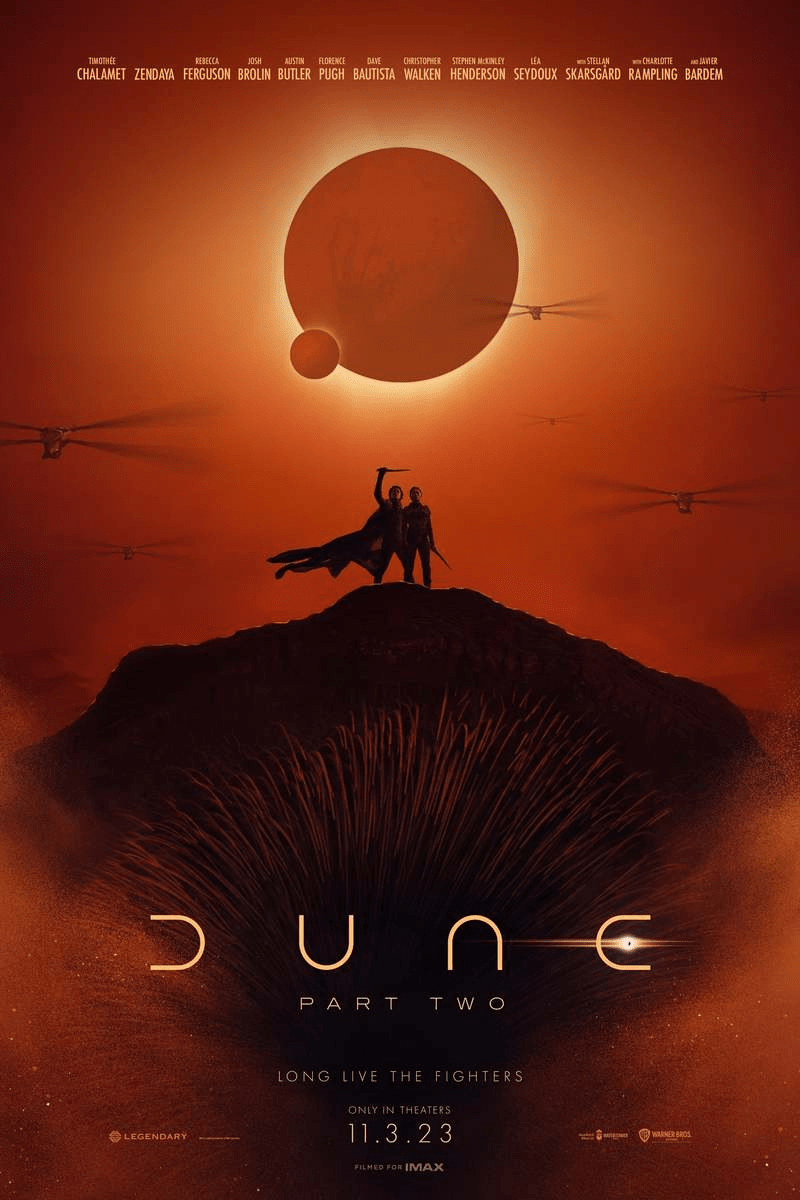
Dune Part 1 is directed by Denis Villeneuve, and stars Timothée Chalamet, Rebecca Ferguson, Oscar Isaac, Zendaya, Stellan Skarsgård, Josh Brolin and Jason Momoa. It is based on the 1965 novel by Frank Herbert and roughly covers the first third to half of the book and will be continued into Part 2 this year.
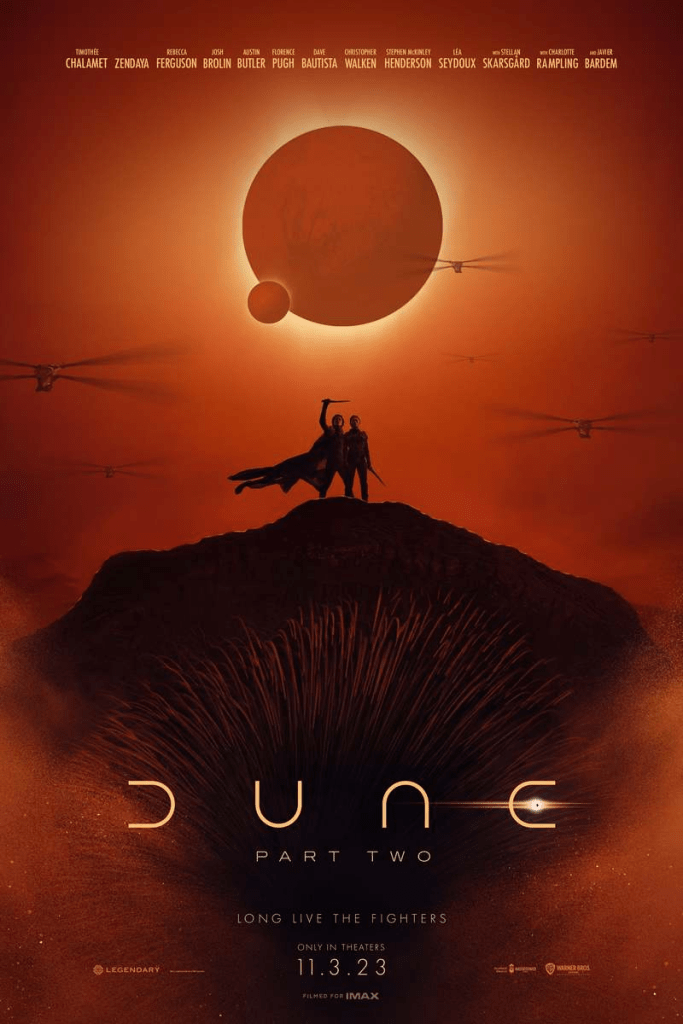
In honour of Dune Part 2 releasing at long last, Dune Part 1 was re-released in theatres in part to milk a little more cash from the film, and also serves as a good refresher of all that goes on in that first movie. Something very helpful since it originally released in 2021, and thanks to that pesky strike, its sequel came a little later than planned.
And a refresher is a good idea in a story so deep and dense as Dune. Just all of Paul Atreides’ (Timothée Chalamet) titles and names are tricky to remember for even the most fervent of fans. Sure its easy to recall Muad’Dib and the Kwisatz Haderach, and that he is the new Duke of the House Atreides, but do you remember Mahdi, Usul, or Lisan al Gaib?
Going back also allows us to take a look at that first part again, what worked, what didn’t and how much is riding on Part 2.
Dune is a dense story with many different factions, names, occupations and immense world-building. The House Atreides inherits Arrakis, or Dune, arguably the most important planet in the universe, since it provides the all important Spice, required for long distance travelling.
However, the former rulers of Arrakis, the ruthless Harkonnens, aren’t looking to give up their cash cow so easily and are planning a hostile takeover of what was once theirs. But that is the barest of rundowns. There is so much lore and world-building crammed into a relatively short book that making it one movie would undoubtedly feel rushed, or skip a lot (case in point the 1984 film).
So the natural thing to do is to break the story into two. The only question is…
How Do You Rate Half A Movie?
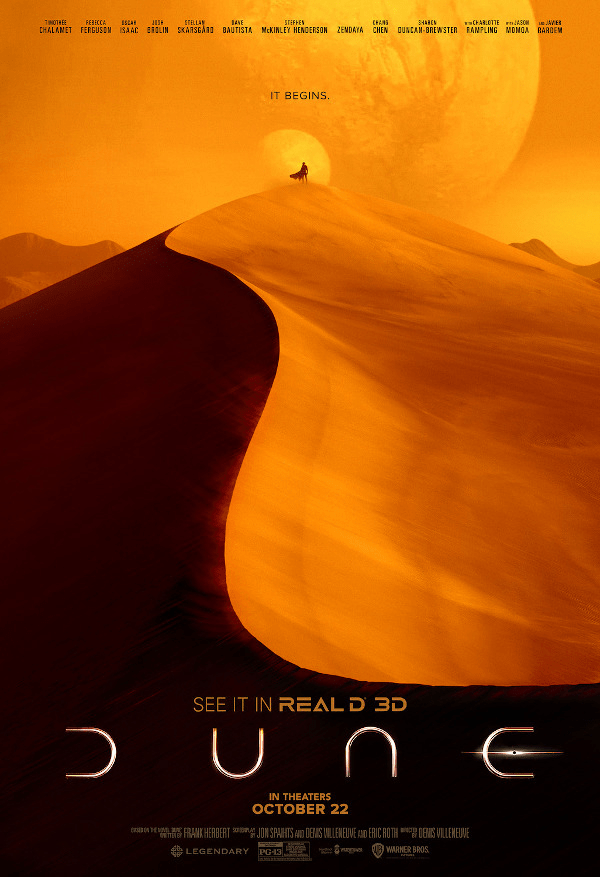
On a moment-to-moment, scene-to-scene basis, Dune Part 1 is pretty great. The acting is great, the direction is slick and gripping and the special effects are gorgeous at many points. The story is exciting and fantastic, but what else do you expect from a movie inheriting the story of one of the most beloved science fiction novels of all time?
The problem? Watching Dune Part 1 is a very unsatisfying watch. The story ends at arguably the darkest point in the story. The House of Atreides has fallen, House Harkonnen has retaken control of Arrakis, and Paul and his Mother (Rebecca Ferguson) are on the run, making a shaky alliance with the native Fremen.
Now this isn’t too uncommon in multi-part stories for one segment to end at a dark moment. The Two Towers ends with Rohan barely surviving an attack from the Army of the White Hand, and Frodo and Sam face the hardest leg of their journey, with their guide deciding to sabotage them for his own nefarious machinations.
Harry Potter and the Half Blood Prince ends with the death of Dumbledore, the wisest, most powerful wizard on the good side, betrayed by a main character, and little hope for Harry and co to find all the Horcruxes and take down Voldemort.
The thing is these are all designed to be cutting off points. The Two Towers ends with with the destruction of around half of evil’s forces, and the idea that the final leg of the journey is here. Harry Potter had the built in device of every book/movie taking place over one year, and with the clear goal set out of destroying all of the Horcruxes.
But Dune was written and conceived as one story, and a lot of it is so interconnected with foreshadowing and just general wibbly-wobbly timey-wimey stuff. The knife fight between Paul and Jamis (Babs Olusanmokun) goes from a ratcheting up of tension between the Atreideses and the Fremen, it becomes a climax to an entire film.
And again, the fight itself is well done and exciting. But as a resolution to the entire film? It is a little bit obtuse, especially with all of the often contradictory visions Paul receives throughout the movie, especially when it comes to Jamis. It makes sense after thinking for a few minutes, but doesn’t make for a very satisfying ending.
Sticking The Landing

There’s this little movie that came out in 2018 called The Perfection. It stars Allison Williams from Get Out and Steven Weber from iZombie and Wings. I won’t spoil anything here, but it teaches a big lesson about sticking the landing.
The first half of The Perfection is pretty much perfection. Its really tense, exciting and at times terrifying, and although there are some minor holes, it all-in-all is a pretty fantastic start. However, it only takes up half the runtime; there’s a whole other half to go through.
And it low-key sucks.
The story doesn’t make very much sense and it gets more than a little goofy. I like the ultimate place and last shot of the movie, but to get there it completely botches the landing.
So instead of wholeheartedly suggesting watching The Perfection, I put a huge caveat on that, and recommend it more as a curiosity than an actual good movie. But man, that first half is great.
And that is the place that Dune Part 1 finds itself. If Part 2 fails to stick the landing, and turns out to be bad or just okay, Part 1 faces a steep uphill battle to be worth a rewatch or being remembered.
Not that I am worried about Dune Part 2. For my money, Villeneuve hasn’t made a bad movie, has set up a solid base in Part 1, and has a great blueprint in the book. However, the first half of Dune is the most conventional part of the Dune series, and the book and its sequel, Dune Messiah, just become more and more atypical as it goes.
The One Misstep
Dune Part 1 follows Dune pretty faithfully. There are small changes, like the cutting of the greenhouse in the palace, and the changing of Liet-Kynes (Sharon Duncan-Brewster) from male to female, which ultimately doesn’t change the story in a very significant way.
The only thing that I can really say the film dropped the ball on was the mystery of the first half of the book: who betrayed House Atreides?
There are long chunks of the book where the characters know someone has betrayed them to the Harkonnens, but no one knows who it was, and everyone suspects everyone. Everyone is walking on eggshells, and a standout scene is where Duncan Idaho goes on a drunken tirade and accuses Jessica as the spy, and her and Thufir Hawat have a tense standoff. Its a genuine mystery and really surprising when it is revealed that the traitor is Yueh.
Yueh in the book and film is a Suk doctor. As mentioned in the book, Imperial training makes it impossible for Suk doctors to cause harm in any way. Its essentially programmed into them. There isn’t a choice in the matter, not like the Hippocratic Oath today, which is a choice.
So when House Atreides is betrayed and people are killed, Yueh is essentially ruled out due to the fact that he cannot due harm. However, Piter de Vries, the Mentat for House Harkonnen corrupts and breaks Yueh, and the reveal of his treachery is a genuine shock.
Unfortunately, Yueh’s betrayal is set up, and payed off in the same scene basically, and the idea of his Imperial Oath making this an impossibility is unfortunately cut.
Is missing the mystery of the betrayer a small thing? Sure. But it also is the clearest and largest example of the movie missing something from the novel.
Luckily, the book narrows down significantly from in on out. All of the ideas of Bene Gesserits and Mentats and Spice are all set up, and for a while, it becomes the story of Jessica, Paul and the Fremen. Most of the cast is cut down from the first half of the book, but it becomes more spiritual and allegorical that will be interesting to see how it plays out in Dune Part 2.
The first movie set up some of the more obtuse aspects of the second half of the story, including precognition, divergent timelines and the jihad to come, but it will take a deft hand to visualize the literal mind-blowing elements of Dune. Not to mention the planned third film based on the second book, Dune Messiah which deconstructs many common storytelling tropes, and even parts of Dune itself.
But if anyone can pull it off its Denis Villeneuve. Whether its the circular story of Arrival, or the tightly-woven (like a spider’s web) Enemy, to the deep and bombastic Blade Runner 2049, he has proven himself to be able to be able to convey challenging ideas in a crowd-pleasing way that should hopefully carry over to Dune Part 2 and beyond.
Let me know what you expect for Dune Part 2, and if you think that Dune Part 1 would still be worth visiting if its sequel doesn’t stick the landing.
 The Sensations of Storytelling