I just finished The Cabin at the End of the World by Paul Tremblay. The book is the basis for the upcoming Knock at the Cabin by M. Night Shyamalan starring Dave Bautista, Jonathan Groff and Ben Aldritch.

I’m sure the film will have some changes, but this review will contain spoilers for the book and potentially the movie. I would recommend the book, with some caveats. It is short, but drags through the middle a bit, and some of the characters bleed into each other. Leonard, Wen and Redmond are distinct enough characters, but Eric and Andrew, and Adriane and Sabrina can occasionally be tough to tell apart.
Ambigious To A Fault
So things will get a bit spoiler-y right from the start.
So, the crux of the book hinges on the characters and the reader not knowing if the world is ending or if the intruders are insane. Which is fine, but unfortunately Tremblay paints himself into a corner early and can’t find his way out.
Early on, Leonard gives his speil about the choice, the end of the world and some vagueries about the coming apocalypse. Something about cities flooding, plagues and the sky falling.
The problem comes where Leonard shows earthquakes and tsunamis on the tv to prove his vaguries. But Tremblay doesn’t want to prove or disprove the existance of the coming apocalypse so everything is as vague as possible.
Its very clear early what is going on. The zealots always mention seeing their visions on the television screen, but never before and clearly enough to prove that they were actually seen beforehand.
The Goonies rock is mentioned multiple times in the book, but never before its shown on the t.v. It makes the intruders frustrating to watch because if they are telling the truth, then why not tell the family as much as possible?
All of this would be fine, but it neuters what would have been the story’s greatest strength. And there could have been a way around it. Have the group say they cannot prove anything for the ritual to work. Or for one to start, only to be hushed by the others. Instead, its never brought up and the villians look idiotic for it.
Oh The Misery!

I saw comparisons between this and Misery before reading, and I have to agree. Both are stories of people being held against their will in a secluded cabin by people of questionable sanity. Both are stories of suspense punctuated with splashes of violence.
The thing is that Misery wears its heart on its sleeve. From the start, everyone knows something is up with Anne Wilkes so King can waste no time developing and exploring Wilkes’ character to its full extent. The suspense comes from whether or not Paul Sheldon can escape, not if Anne Wilkes is crazy or not.
Leonard is the Anne Wilkes of The Cabin at the End of the World, and the family is Paul Sheldon. And while Paul is a fine enough character, everyone comes for Anne.
The thing is, Leonard is like if Anne Wilkes didn’t do anything crazy until at the end of the story to try to build suspense of whether she was crazy or not.
But those insane moments are what makes Anne Wilkes such a compelling character, and we would be missing a lot of that if King wasted time trying to trick the reader into thinking she might not be crazy.
Leonard is this book’s Anne, and to a lesser extent Redmond, Adriene and Sabrina are too. But we never get enough information or character to get invested into these characters.
It would be interesting to hear about their visions in detail, or what exactly they believe in and expand on their strange rituals and weird weapons, but that would mean proving if their beliefs or not.
A Lack of Movement
Okay, so back to Misery. Paul may be trapped in a cabin, but there is a lot of movement. Annie leaves, Paul escapes the room, he gains things, he loses things, hatches schemes and becomes hobbled.
So despite being trapped, we always feel as if Paul is progressing and moving towards something, be it his own demise or freedom.
That’s not the case with The Cabin at the End of the World.
Once the initial break in and fight happens, Eric and Andrew spend a vast majority of the book tied to chairs with no changes other than the tightness of their bonds. Which, unfortunately, gives the story a lack of momentum and the book drags in the middle.
Wen is underutilized in this section of the novel. We lose a lot of her point of view through this time even though she is one of the few characters free and with agency in the story. But she winds up doing nothing anyways.
The Trolley Problem
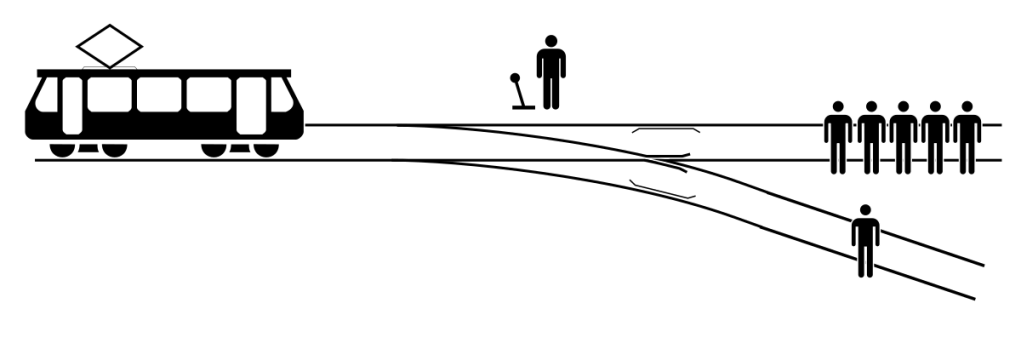
The story is essentially a complex version of the trolley problem. The trolley problem is one of the most famous morality thought experiences ever, saying that a trolley is speeding towards a group of people on the tracks, but you can divert the trolley and in doing so kill one person. The morality comes from the fact that the person at the controls would actively choose and “murder” one person to save others.
That is the dilemma that Leonard gives Eric, Andrew and Wen. Kill one of your own or the world will end. Can you kill to save others? Is it worth it?
But what if you don’t know the trolley exists?
At this point in history the trolley problem is well trodden ground, but the characters don’t put any thought into it outside of outright denying it immediately.
Which isn’t itself an issue, that’s a totally valid reaction, it just feels like a missed opportunity especially knowing how the rest of the book goes. Having a philosophical throughline and debate would have made the static second act feel more interesting and engaging.
But I feel that that would have given too much information and tipped the reader into believing Leonard or not. And because of that it never feels like the story realizes its philosophical potential.
Conclusion
There are other nitpick-y and personal things as well. Whole paragraphs are dedicated to describe the plots of cartoons shown on T.V. for Wen. I personally don’t like it when stories reference other stories or media, especially if there isn’t a really good point for it. Like mentioning the weapons look like something the orcs in Lord Of The Rings would use feels very lazy to me.
Also, the book is written in a tight third person perspective, with that perspective shifting constantly through the story. However, at the end Tremblay switches to two different first person views in a jarrimf and baffling decision. I don’t know why he chose to do it. There isn’t anything that feels purposeful or needed until the end, but changing ‘He’s to ‘We’s just feels confusing.
I am hesistantly excited for the movie still. We have gone from good Shyamalan to bad and now its swung back around to be okay. I liked Split and Glass but thought Old was hilarious with how serious and bad it was. There are some interesting camera techniques used and I expect some sort of interesting Shyamalan twist.
 The Sensations of Storytelling